Agent Team Skills
Four skills for Claude Code

Run a team of Claude sessions without reading every chat.

restart-ready lets any session restart without losing work. build-review-loop has a second session check the first one's work. chief-of-staff puts one session between you and the rest of the team. owner-desk gives you one board for everything only you can decide or do. Use what you need.

restart-ready build-review-loop chief-of-staff owner-desk

Who talks to whom

Without builder reviewer tester feedback you relay by hand find the question

You are the switchboard. Every message passes through you, questions hide in four chats, and nobody notices when a session stops.

With the skills you owner-desk chief-of-staff builder reviewer tester feedback answer any time sessions hand work to each other

You have one conversation. The team talks to itself, the chief of staff keeps it moving, and what needs you waits on the desk.

What changes in your day

Each row is a problem that shows up once you run more than two or three sessions, and what the skill does about it.

WithoutYou copy messages from one chat to another, and shorten them as you go.

chief-of-staff

Your words go to the right session exactly as you wrote them, starting “the owner says:”, and you're told where they went.

WithoutQuestions are spread over five chats, each asked in its own way.

chief-of-staff

You get one numbered round, each question with a recommended answer. You can reply “1 yes, 2 no” from your phone.

WithoutYou can't tell who is working, who is waiting, and who is waiting for you.

chief-of-staff

A status page shows each session's state, its last message in one line, what's waiting for you, and what's next.

WithoutA session stops at a usage limit, or waits for a message that never comes, and nobody notices for hours.

chief-of-staff

After every report it checks each session, resends work that stalled, and nudges the one that's waiting.

WithoutLong chats get slow and forgetful, and restarting one loses what only lived in that chat.

restart-ready

Everything a session knows lives in a few short files. It says when it's a good moment to restart, then writes the prompt for its own replacement. You paste it into a fresh session, and nothing is lost.

WithoutYour AI says all the tests pass, and the bug is still there.

build-review-loop

A second session checks the exact commit in its own copy, re-runs everything, and makes sure each new test fails on the old code. Only real problems send work back.

WithoutA task only you can do, such as an upload or a sign-in, is a long paragraph you have to scroll back to find.

owner-desk

It gets its own card, with steps to tick, text to copy and the guide attached.

WithoutYou answer when the agent asks, not when you have time, and answered questions pile up with open ones.

owner-desk

You answer on the desk whenever you like. Answered items move to a Decided group, the agent acts on them and archives them, and questions for later wait on their own tab.

The four skills

restart-ready

Sessions you can throw away

A long chat gets slow and forgetful. If everything that matters is in files, a fresh session picks up where the old one stopped.

  • Keeps a short state file: done, in progress, next, waiting for whom. History goes to a separate log.
  • Reads only what the step needs, and sends wide searches to a sub-agent.
  • Writes corrections down at once, so the next session doesn't repeat them.
  • Ends each unit of work by saying whether it's a good moment to restart it.
end of a review Context: long, after three reviews. Good moment to restart me: yes. Everything is committed.
build-review-loop

Two sessions that check each other

A builder builds one step of the plan at a time. An independent reviewer, on a different model, checks it before the next step starts.

  • The reviewer checks the exact commit in its own copy, and re-runs everything.
  • One verdict: PASS, FIX with a numbered list, or STOP for you.
  • Only real problems block: lost data, privacy, wrong results, a broken build. Style doesn't.
  • Two disagreements on the same point come to you. An optional tester tries to break the risky parts.
to: builder Verdict: FIX. 1. The new test also passes on the old code, so it proves nothing.
chief-of-staff

One session between you and the team

It doesn't build, review or design. It runs the team's communication and protects your time, like a chief of staff in a company.

  • Passes your words on word for word, and brings each session's questions back to you.
  • Looks up facts itself, and asks you only for decisions, in one numbered round.
  • Keeps the hand-offs moving and resends work that stalled.
  • Keeps a short status page in your repo.
  • Tells you when a session should restart fresh, and has it write its own replacement prompt.
  • Sends you a notification only when something needs you.
to: builder the owner says: “Ship the fix after the reviewer's PASS.” to: you 3. Move the release to Friday? Recommended: yes. 4. Restart the reviewer now? Its chat is long. Recommended: yes.
owner-desk

A board for what only you can decide or do

A live page with its own small database. The agent posts items to it; you answer on your phone whenever you have time.

  • Each item has a recommended answer and buttons.
  • Tasks come with steps to tick, text to copy, links and files.
  • Ask a question on any item, and the answer shows on the same tab.
  • Optional Status, Updates and Roadmap tabs: where every session stands, what changed once it passed review, and where the project is in its plan.
  • Feedback from testers gets its own tab, so it never adds to what needs you.
  • Needs you, Decided, Later and Archive tabs keep what still needs you apart from everything else, and an Urgent tab appears when something can't wait. Swipe sideways to move between them.
Overview Needs you 2 Decided 1 Later 2 Archive 9
№ 12DecisionNeeds youfrom builder

Open the beta to testers this Friday?

RecommendedYes. The reviewer passed every fix, and the release notes are ready.

An example item, with made-up content. The buttons work on this page only.

The desk on an iPad

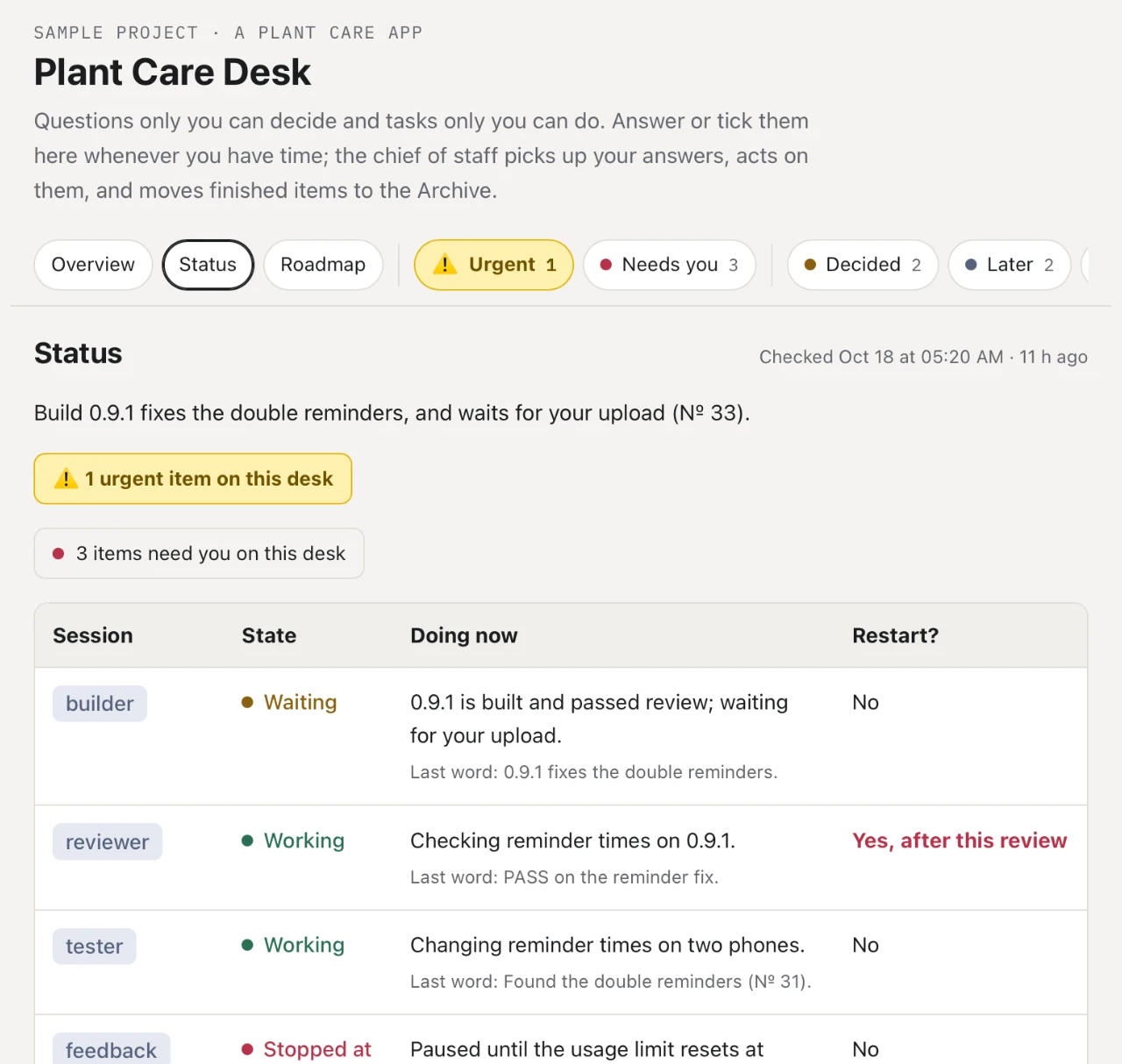
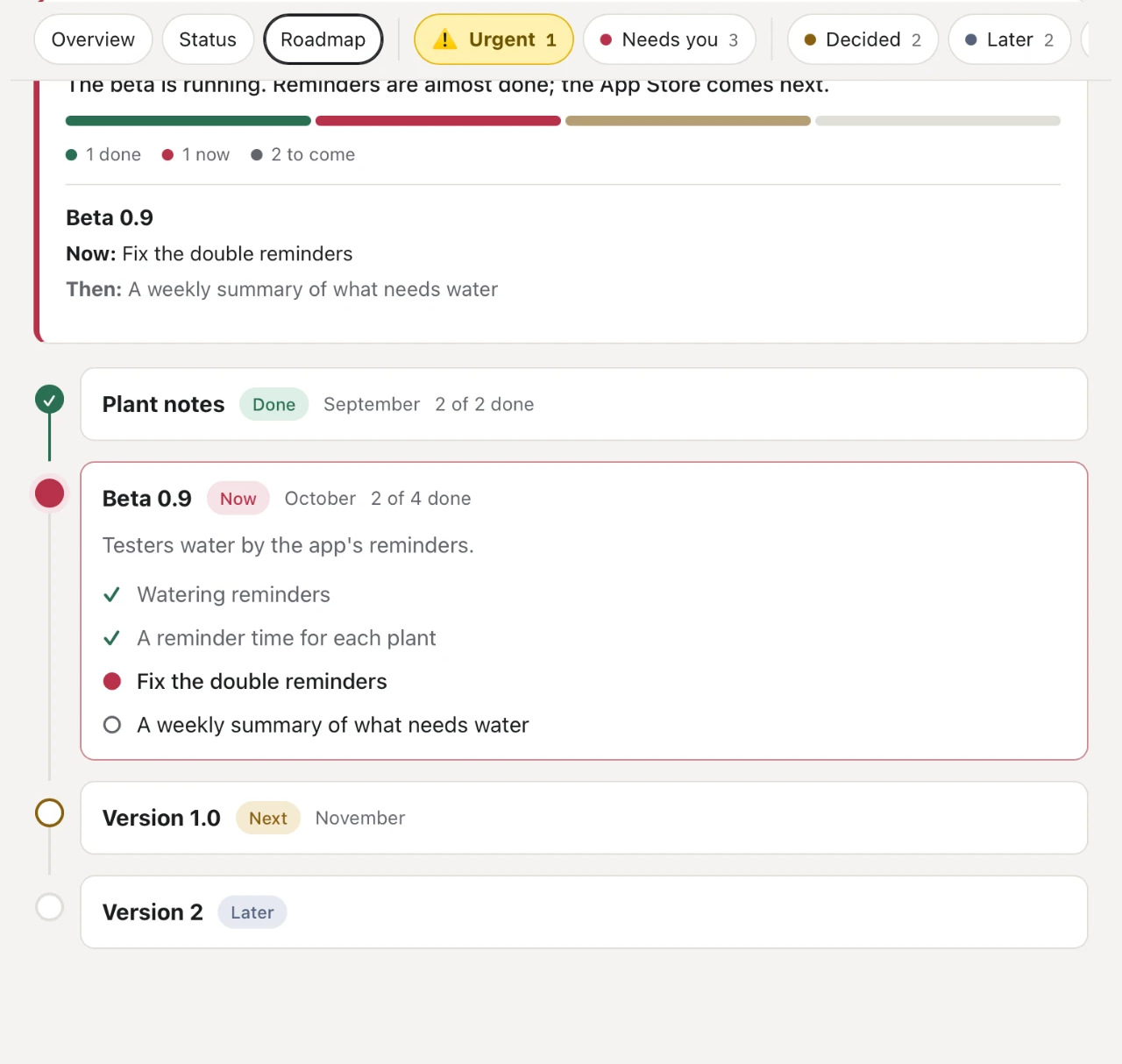
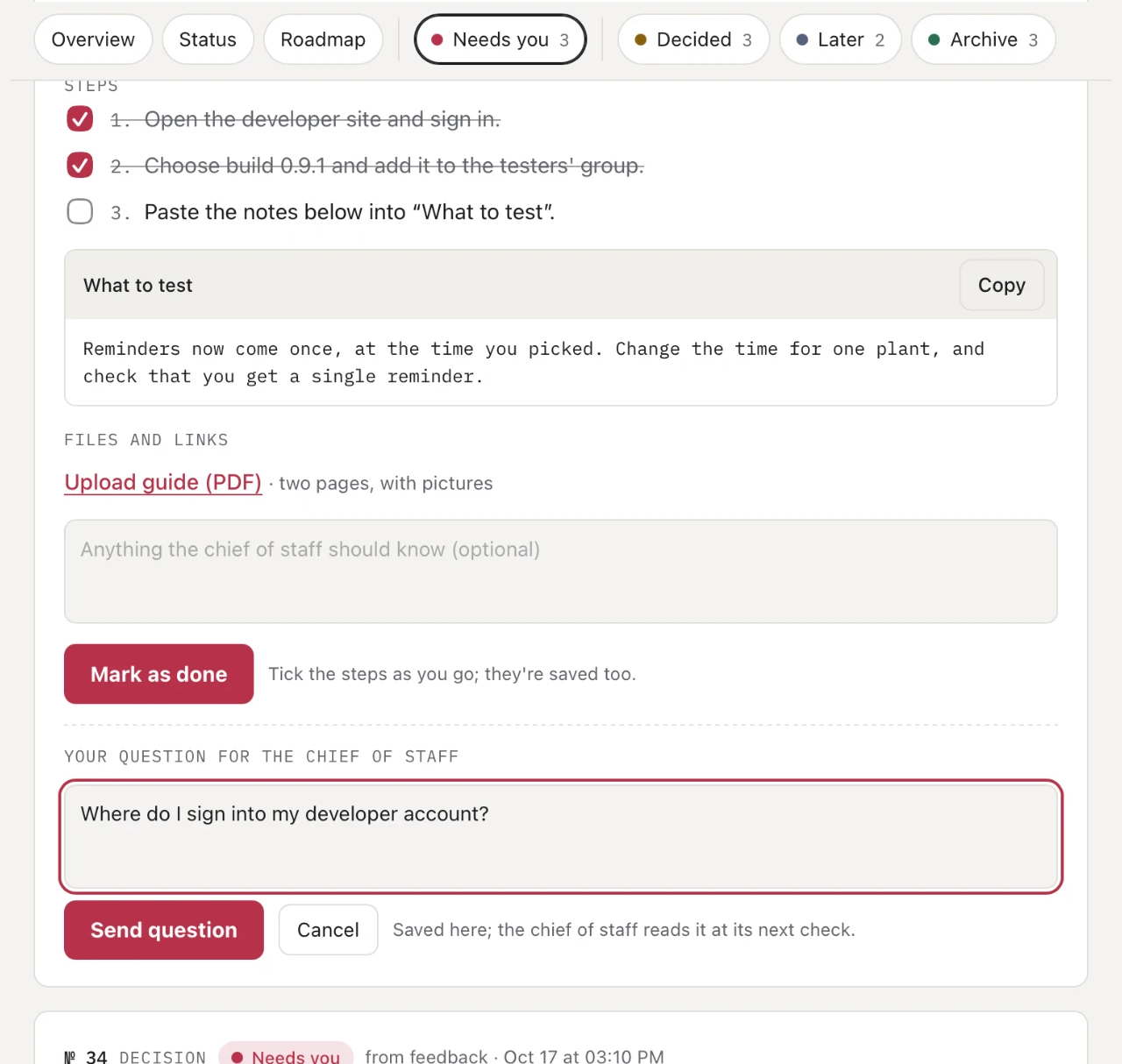
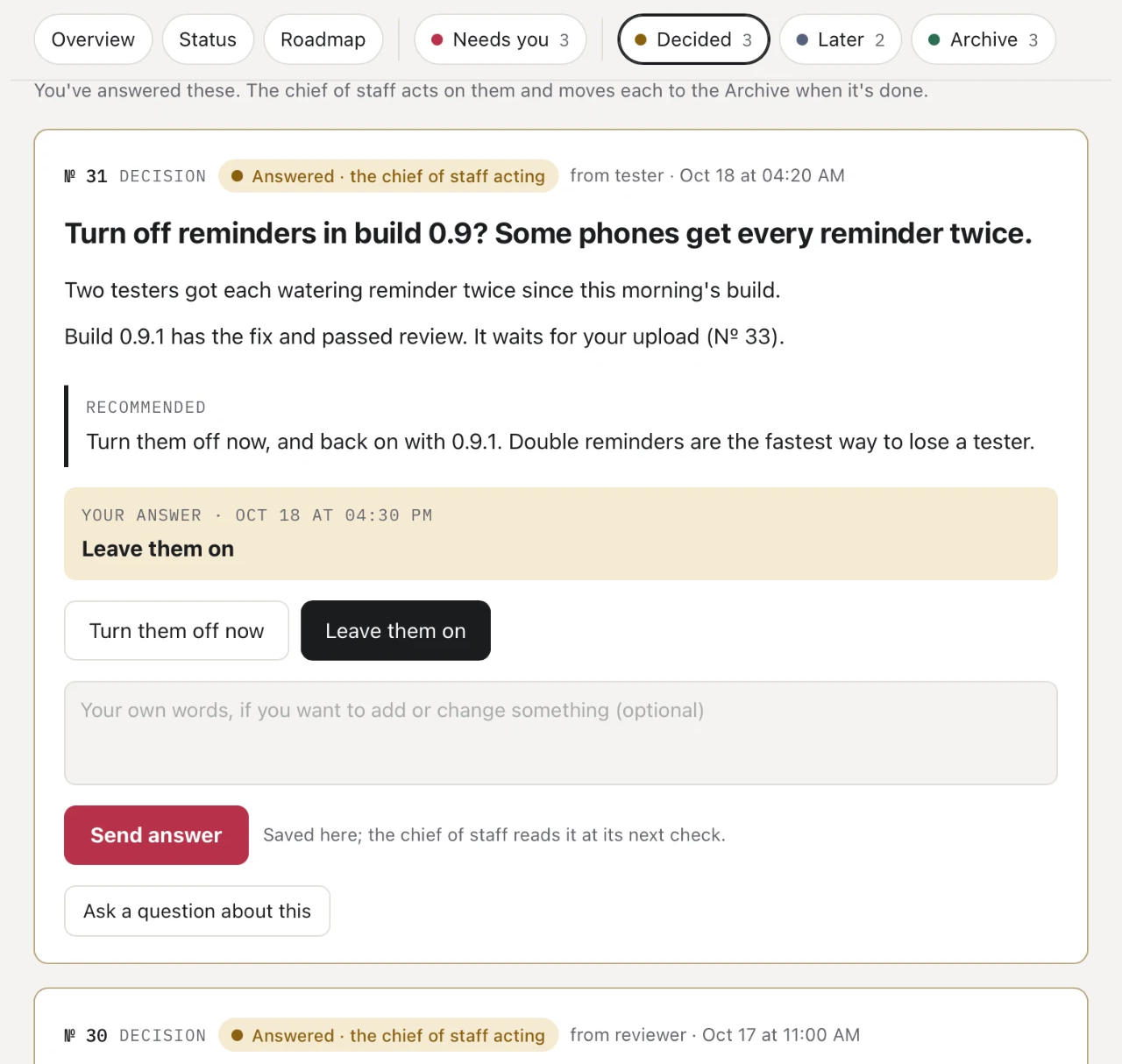
Screenshots of a sample desk, for a made-up plant care app. On the desk, you swipe left or right to move between tabs.

The Status tab on an iPad: one line on where the project stands, buttons to the one urgent item and the three that need you, and a table of four sessions with their state, what each is doing, and whether to restart it
Status. Every session's state, what it's doing, and whether it's time to restart it.
The Roadmap tab on an iPad: a track of four stages, the current stage with what's now and what's next, and a timeline with the current stage open and its items ticked off
Roadmap. The plan stage by stage, with the current stage and its next step on top.
A task on an iPad: two of three steps ticked, text to copy, a guide to open, and a question for the chief of staff being written
A task for you. Steps to tick, text to copy, and a question for the chief of staff.
The Decided tab on an iPad: a decision with the owner's saved answer, and buttons to change it
Decided. Your answer is saved, and you can change it until the chief of staff acts on it.

Use what you need

One session

restart-ready: restart whenever the chat grows, and lose nothing.

Two sessions

Add build-review-loop: one builds, the other checks every step.

Three or more

Add chief-of-staff: you talk to one session, and it runs the rest.

Decisions piling up

Add owner-desk: one board for what only you can decide or do. With a chief of staff, it's the only one that writes to it.

Rules it keeps

  • Your words are never shortened, softened or added to on the way.
  • Decisions are yours. Facts the agents look up themselves before asking.
  • Nothing is installed, bought, published or deleted without your word. A session can't get that permission from the chief of staff.
  • A session's report isn't proof. Before telling you something is done, the chief of staff reads the file or result that shows it.
  • Everything that matters lives in files, never only in a chat, so any session can restart at any time.

What you need

restart-ready works in any Claude Code session.

build-review-loop and chief-of-staff need the Claude desktop app (Code tab), where sessions can see and message each other.

owner-desk needs Claude artifacts with a database, in claude.ai or the desktop app.

Where it comes from

All four came out of a real project: an iPhone app built by a team of Claude sessions, taken from its first decision to a beta with testers in 9 days. The owner wrote no app code and made every decision.

Why I built this

I wanted to build an iPhone app without it being limited by what I know. I'm not a Swift developer, and I didn't want to learn how to structure a Swift project before I could start. So I let Claude write all of the code, and I kept every decision for myself.

That worked, but problems came quickly. The biggest one was context. The longer a session ran, the faster it burned through my usage, and most of what it carried wasn't needed. But if I started a fresh session, I had to explain everything again.

Having a chief of staff also made the whole setup modular. When I need something new done, I add a session for that one job and connect it to the chief of staff, without explaining the project to it. Once the app was in beta, I added a session that reads the testers' feedback, and a tester that drives the iPhone Simulator and tries edge cases I'd never have thought of.

kl-autonomous
12blocking problems the reviewer caught before anything merged
12restarts, with nothing lost
18 / 30desk items closed on the desk's first day